
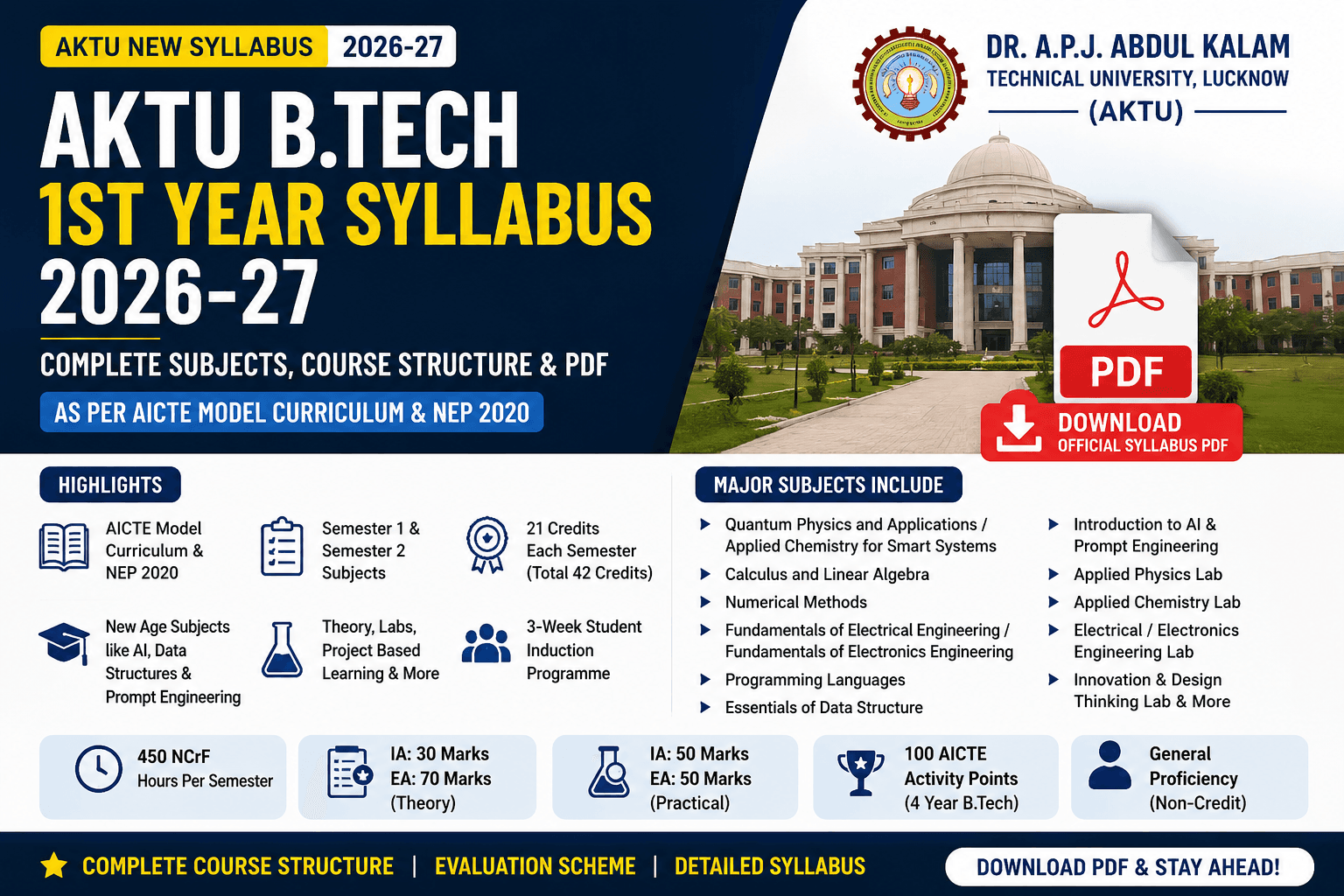
AKTU B.Tech 1st Year Syllabus 2026-27: Complete Subjects, Course Structure & PDF
Looking for the AKTU B.Tech 1st Year Syllabus 2026-27 PDF? This guide brings together the official CSE Stream course structure, Semester I and II subjects, credits, evaluation details, branch guidance and links to unit-wise syllabus pages.
Download the AKTU B.Tech 1st Year Syllabus 2026-27 PDF →
Use this overview to find your semester and subject, then open the detailed guide for the exact course. Course combinations can vary by branch, so confirm your subjects against the official scheme and your college's applicable instructions.
Quick links: Semester I syllabus · Semester II syllabus · Subject codes explained
Dr. A.P.J. Abdul Kalam Technical University (AKTU), Lucknow has released the B.Tech First Year CSE Stream Syllabus for the academic session 2026-27. The new curriculum is based on the AICTE Model Curriculum and NEP 2020 and is applicable from the 2026-27 academic session.
If you are taking admission in B.Tech 1st Year under AKTU in 2026-27, this page will help you understand the complete first-year course structure, semester-wise subjects, credits, evaluation scheme, practical courses, and other important requirements.
The official syllabus covers the Computer Science & Engineering (CSE) Stream, which includes several computer-related branches such as Computer Science and Engineering, Computer Science, Computer Engineering, Information Technology, Artificial Intelligence, Artificial Intelligence & Machine Learning, Data Science, Cyber Security, Internet of Things and other related programmes.
AKTU B.Tech 1st Year Syllabus 2026-27 PDF
Students can download and refer to the official AKTU B.Tech First Year CSE Stream Syllabus 2026-27, which contains the complete course structure, syllabus and evaluation scheme.
AKTU B.Tech 1st Year Syllabus 2026-27 – Official PDF
The official document is titled “Evaluation Scheme & Syllabus of B.Tech. First Year CSE Stream” and is effective from the 2026-27 academic session. It has been prepared as per the AICTE Model Curriculum and NEP 2020.
AKTU B.Tech 1st Year Syllabus 2026-27: Overview
The AKTU B.Tech First Year CSE Stream curriculum is divided into Semester I and Semester II.
Each semester carries 21 credits, making the total first-year credit load 42 credits for the CSE Stream structure. The official scheme lists 450 NCrF hours per semester.
| Particular | Details |
|---|---|
| University | Dr. A.P.J. Abdul Kalam Technical University, Lucknow |
| Programme | Bachelor of Technology (B.Tech.) |
| Academic Session | 2026-27 |
| Stream | Computer Science & Engineering Stream |
| Year | First Year |
| Semester I Credits | 21 |
| Semester II Credits | 21 |
| Total First-Year Credits | 42 |
| Curriculum | AICTE Model Curriculum & NEP 2020 |
| Student Induction Programme | 3 Weeks |
| AICTE Activity Points | 100 for regular 4-year B.Tech |
The first-year structure includes theory courses, laboratory courses, skill/project-based learning, non-credit mandatory courses and other components designed to provide both technical and professional development.
AKTU B.Tech 1st Year Subjects 2026-27
The AKTU B.Tech 1st Year syllabus 2026-27 includes subjects from mathematics, physics, chemistry, electrical and electronics engineering, programming, data structures, artificial intelligence, communication and other engineering areas.
Major subjects and courses in the CSE Stream include:
Quantum Physics and Applications
Applied Chemistry for Smart Systems
Calculus and Linear Algebra
Numerical Methods
Fundamentals of Electrical Engineering
Fundamentals of Electronics Engineering
Programming Languages
Essentials of Data Structure
Introduction to Indian Knowledge System
Professional Communication & Technical Writing
Introduction to AI & Prompt Engineering
Fundamentals of Mechanical Engineering
Applied Physics Lab
Applied Chemistry for Smart Systems Lab
Electrical Engineering Lab
Electronics Engineering Lab
Computer-Aided Engineering Drawing Lab
Innovation & Design Thinking Lab
Language Lab
Environment & Sustainability
General Proficiency
Some courses are provided as alternatives depending on the applicable branch and stream structure. Therefore, students should check the official course structure for their particular B.Tech branch before finalising their subject list.
AKTU B.Tech 1st Semester Syllabus 2026-27
The AKTU B.Tech 1st Semester syllabus 2026-27 carries 21 credits. We've covered the complete semester breakdown separately in our AKTU B.Tech 1st Semester Syllabus 2026-27 guide, but here's the official structure at a glance:
| S.No. | Course | Category | Credits |
|---|---|---|---|
| 1 | Quantum Physics and Applications / Applied Chemistry for Smart Systems | BSC | 3 |
| 2 | Calculus and Linear Algebra | BSC | 4 |
| 3 | Fundamentals of Electrical Engineering / Fundamentals of Electronics Engineering | ESC | 3 |
| 4 | Programming Languages | ESC | 3 |
| 5 | Introduction to Indian Knowledge System / Professional Communication & Technical Writing | HSMC | 2 |
| 6 | Introduction to AI & Prompt Engineering / Fundamentals of Mechanical Engineering | ESC | 2 |
| 7 | Applied Physics Lab / Applied Chemistry for Smart Systems Lab | BSC | 1 |
| 8 | Electrical Engineering Lab / Electronics Engineering Lab | ESC | 1 |
| 9 | Computer-Aided Engineering Drawing Lab / Innovation & Design Thinking Lab | ESC/SDC | 2 |
| 10 | Language Lab / Environment & Sustainability | BSC/NCMC | Non-Credit |
| 11 | General Proficiency | NCMC | Non-Credit |
Semester I Structure
The official scheme contains:
16 Lecture hours
4 Tutorial hours
10 Practical hours
450 NCrF Hours
21 Credits
A 3-week Student Induction Programme is also specified at the beginning of the session as per AICTE guidelines.
Read the complete syllabus: AKTU B.Tech 1st Semester Syllabus 2026-27 →
AKTU B.Tech 2nd Semester Syllabus 2026-27
The AKTU B.Tech 2nd Semester syllabus 2026-27 also carries 21 credits. Full subject-wise details are in our AKTU B.Tech 2nd Semester Syllabus 2026-27 guide.
The Semester II course structure includes:
| S.No. | Course | Category | Credits |
|---|---|---|---|
| 1 | Quantum Physics and Applications / Applied Chemistry for Smart Systems | BSC | 3 |
| 2 | Numerical Methods | BSC | 4 |
| 3 | Fundamentals of Electrical Engineering / Fundamentals of Electronics Engineering | ESC | 3 |
| 4 | Essentials of Data Structure | ESC | 3 |
| 5 | Introduction to Indian Knowledge System / Professional Communication & Technical Writing | HSMC | 2 |
| 6 | Introduction to AI & Prompt Engineering / Fundamentals of Mechanical Engineering | ESC | 2 |
| 7 | Applied Physics Lab / Applied Chemistry for Smart Systems Lab | BSC | 1 |
| 8 | Electrical Engineering Lab / Electronics Engineering Lab | ESC | 1 |
| 9 | Computer-Aided Engineering Drawing Lab / Innovation & Design Thinking Lab | ESC/SDC | 2 |
| 10 | Language Lab / Environment & Sustainability | BSC/NCMC | Non-Credit |
| 11 | General Proficiency | NCMC | Non-Credit |
Semester II Structure
The official Semester II structure contains:
16 Lecture hours
4 Tutorial hours
10 Practical hours
450 NCrF Hours
21 Credits
Read the complete syllabus: AKTU B.Tech 2nd Semester Syllabus 2026-27 →
Important Subjects in AKTU B.Tech 1st Year 2026-27
The revised first-year curriculum contains several important subjects that students should understand before starting their B.Tech course.
1. Calculus and Linear Algebra
Calculus and Linear Algebra is a 4-credit Basic Science Course in Semester I.
It forms an important mathematical foundation for engineering education and is one of the higher-credit theory subjects in the first semester.
Detailed Syllabus: AKTU Calculus and Linear Algebra Syllabus 2026-27 →
2. Programming Languages
Programming Languages is a 3-credit Engineering Science Course included in Semester I for the CSE Stream.
The subject provides students with a programming foundation that supports further study in computer science and engineering.
Detailed Syllabus: AKTU Programming Languages Syllabus 2026-27 →
3. Essentials of Data Structure
Essentials of Data Structure is a 3-credit Engineering Science Course in Semester II.
The course covers fundamental data-structure concepts such as:
Arrays
Linked Lists
Stacks
Queues
Searching
Sorting
Binary Search Trees
Graph concepts
BFS
DFS
Detailed Syllabus: AKTU Essentials of Data Structures Syllabus 2026-27 →
4. Numerical Methods
Numerical Methods is a 4-credit Basic Science Course in Semester II.
It is one of the major-credit subjects in the second semester, and full unit-wise coverage for this subject is on its way — check back soon or explore the other subject guides linked throughout this page in the meantime.
5. Introduction to AI & Prompt Engineering
One of the most notable courses in the AKTU B.Tech First Year CSE Stream syllabus is Introduction to AI & Prompt Engineering.
The syllabus introduces students to:
Artificial Intelligence
Machine Learning
Deep Learning
Natural Language Processing
Computer Vision
Generative AI
Large Language Models
AI applications
AI ethics
Prompt Engineering
Zero-shot prompting
Few-shot prompting
Chain-of-thought prompting
Role prompting
Domain-specific prompting
The course also includes hands-on interaction with AI tools and assignments involving AI-generated responses and prompt development.
Detailed Syllabus: AKTU Introduction to AI & Prompt Engineering Syllabus 2026-27 →
6. Quantum Physics and Applications
Quantum Physics and Applications is a 3-credit Basic Science Course.
The syllabus covers topics including:
Fundamentals of Quantum Mechanics
de Broglie matter waves
Davisson-Germer experiment
Heisenberg's uncertainty principle
Schrödinger wave equations
Quantum theory of solids
Energy bands
Semiconductors
Quantum computation and communication
Photonics
Superconductivity
Nanomaterials
Detailed Syllabus: AKTU Quantum Physics and Applications Syllabus 2026-27 →
AKTU B.Tech 1st Year Exam Pattern 2026-27
The official evaluation scheme specifies Internal Assessment (IA) and External Assessment (EA) for the theory courses.
For the theory courses listed in the first-year scheme, the standard structure shown is:
Internal Assessment: 30 marks
External Assessment: 70 marks
Total: 100 marks
For laboratory courses, the evaluation structure is different and includes practical assessment.
For example, the theory courses in the scheme show 30 marks for internal assessment and 70 marks for end-semester examination, while practical courses show 50 marks internal and 50 marks end-semester practical examination.
Students should therefore check the evaluation scheme for the particular subject instead of applying the theory pattern to every course.
Student Induction Programme in AKTU B.Tech 1st Year
The AKTU B.Tech First Year syllabus includes a 3-week Student Induction Programme (SIP) at the beginning of the session as per AICTE guidelines.
The Student Induction Programme is intended to help newly admitted students adjust to the higher-education environment and understand their institution, branch and academic environment.
The activities mentioned in the syllabus include:
Physical Activities
Creative Arts
Universal Human Values
Literary Events
Proficiency Modules
Lectures by Eminent Personalities
Local Area Visits
Department/Branch Familiarization
Innovation-related Sessions
AKTU AICTE Activity Points 2026-27
Students should also pay attention to the AICTE Activity Points requirement.
For a regular four-year B.Tech programme, students must earn 100 Activity Points between Semester 1 and Semester 8. These points are a mandatory requirement for the award of the degree.
The official requirement is:
| Student Category | Minimum Activity Points |
|---|---|
| Regular 4-Year B.Tech | 100 |
| Lateral Entry | 75 |
| Transferred Students | 50 |
The Activity Points are non-credit and are not counted in SGPA or CGPA. However, they are mandatory for the award of the degree and are reflected in the final Grade Card.
Students can earn these points through approved activities involving areas such as community engagement, innovation, social responsibility, skill development, sustainability and other activities specified under the AICTE Activity Point Programme.
General Proficiency in AKTU B.Tech 1st Year
General Proficiency is included as a mandatory non-credit component in the first-year structure.
The official Standard Operating Procedure specifies:
Marks: 50
Credits: Non-Credit
Nature: Mandatory
Type: Internal Assessment
Its assessment includes areas such as:
Discipline and Ethics
Communication and Leadership Skills
Co-curricular Activities
Teamwork and Collaboration
Professional and Technical Skills
Therefore, students should not assume that only their theory and practical subjects matter in the first year.
Innovation & Design Thinking Lab
The first-year curriculum also provides for Innovation & Design Thinking Lab (Project-Based Learning) as an alternative to Computer-Aided Engineering Drawing Lab in the applicable course structure.
The design-thinking process follows five major stages:
Empathize → Define → Ideate → Prototype → Test
Students may work on real-world problems related to areas such as:
Campus and community
Agriculture and rural development
Health and wellbeing
Sustainability and environment
Education and skilling
Smart living
The course emphasizes teamwork, user research, prototyping, documentation and project presentation.
Language Lab and Professional Skills
The first-year curriculum also places emphasis on communication and employability skills.
The Language Lab includes activities related to:
Listening
Speaking
Reading
Writing
Self-introduction
SWOT analysis
Professional networking
Digital professional branding
Email writing
Notice writing
Agenda and Minutes of Meeting
Technical report writing
Group discussions
Workplace communication
Professional etiquette
Negotiation
Conflict resolution
This shows that the first-year curriculum is not limited to technical subjects and programming. It also includes communication, professional development and practical skills.
AKTU CSE Stream: Branches Covered in 2026-27
The official AKTU stream classification places the following branches under the Computer Science & Engineering Stream (CSE):
Computer Science and Engineering
Computer Science
Computer Engineering
Information Technology
Computer Science and Information Technology
Computer Science & Technology
Computer Science and Design
Computer Science and Engineering (Hindi)
Computer Science and Engineering (Artificial Intelligence)
Computer Science and Engineering (Artificial Intelligence & Machine Learning)
Artificial Intelligence and Machine Learning
Artificial Intelligence (AI) and Data Science
Computer Science and Engineering (Data Science)
Computer Science & Engineering (Cyber Security)
Computer Science and Engineering (Internet of Things)
Cyber Security
Data Science
The official document therefore groups a wide range of computer, AI, data and cyber-related B.Tech programmes under the CSE Stream.
However, students should check their specific branch and applicable course combination, because the course structure includes alternative subjects for different branches.
AKTU B.Tech First Year Course Categories
The syllabus uses different course-category abbreviations.
| Abbreviation | Full Form |
|---|---|
| BSC | Basic Science Course |
| ESC | Engineering Science Course |
| PSC | Programme Specific Course |
| AEC | Ability Enhancement Course |
| NCMC | Non-Credit Mandatory Course |
| SDC | Skill Development Course |
| HSMC | Humanities, Social Science & Management Course |
| AS&H | Applied Science and Humanities |
Understanding these categories can help students read the official AKTU course structure and evaluation scheme more easily.
What Should AKTU B.Tech 1st Year Students Focus On?
Students starting B.Tech under AKTU in 2026-27 should pay attention to more than just the end-semester examinations.
The first-year curriculum combines:
Engineering mathematics
Quantum physics and applied sciences
Programming
Data structures
Electrical and electronics fundamentals
Artificial Intelligence
Prompt Engineering
Communication skills
Indian Knowledge System
Practical laboratory work
Innovation and Design Thinking
Professional development
General Proficiency
AICTE Activity Points
The inclusion of AI & Prompt Engineering, Data Structures, project-based learning, professional communication and AICTE Activity Points makes it important for students to understand the complete first-year structure from the beginning of the academic session.
Frequently Asked Questions
When is the AKTU B.Tech 1st Year Syllabus 2026-27 applicable?
The syllabus is effective from the 2026-27 academic session.
How many credits are there in AKTU B.Tech 1st Year?
The CSE Stream structure contains 21 credits in Semester I and 21 credits in Semester II, making a total of 42 credits for the first year.
Is AI included in the AKTU B.Tech 1st Year syllabus?
Yes. Introduction to AI & Prompt Engineering is included in the first-year CSE Stream course structure.
Is Prompt Engineering part of the AKTU syllabus?
Yes. Prompt Engineering is explicitly covered in the Introduction to AI & Prompt Engineering course. The syllabus includes zero-shot prompting, few-shot prompting, chain-of-thought prompting, role prompting and domain-specific prompting.
Is Data Structure included in AKTU B.Tech First Year?
Yes. Essentials of Data Structure is included in Semester II of the CSE Stream syllabus.
How many AICTE Activity Points are required for B.Tech?
Regular students enrolled in a four-year B.Tech programme must earn 100 AICTE Activity Points.
Does AKTU B.Tech First Year include a Student Induction Programme?
Yes. The syllabus specifies a 3-week Student Induction Programme at the beginning of the session as per AICTE guidelines.
Is General Proficiency a credit subject?
No. General Proficiency is a mandatory non-credit component carrying 50 marks under internal assessment.
Is Innovation and Design Thinking included in the syllabus?
Yes. Innovation & Design Thinking Lab (Project-Based Learning) is included as an applicable first-year course option.
AKTU B.Tech 1st Year Syllabus 2026-27: Important Links
AKTU B.Tech 1st Year Syllabus 2026-27 PDF
Download Official Syllabus PDF →
AKTU B.Tech 1st Semester Syllabus 2026-27
View Semester 1 Syllabus →
AKTU B.Tech 2nd Semester Syllabus 2026-27
View Semester 2 Syllabus →
AKTU AI & Prompt Engineering Syllabus 2026-27
View Subject Syllabus →
AKTU Programming Languages Syllabus 2026-27
View Subject Syllabus →
AKTU Essentials of Data Structures Syllabus 2026-27
View Subject Syllabus →
AKTU Calculus and Linear Algebra Syllabus 2026-27
View Subject Syllabus →
AKTU Quantum Physics and Applications Syllabus 2026-27
View Subject Syllabus →
Conclusion
The AKTU B.Tech 1st Year Syllabus 2026-27 introduces a broad first-year curriculum for students in the CSE Stream, covering mathematics, science, engineering fundamentals, programming, data structures, artificial intelligence, Prompt Engineering, communication, Indian Knowledge System, practical learning and professional development.
The official curriculum is effective from the 2026-27 academic session and follows the AICTE Model Curriculum and NEP 2020.
For students entering B.Tech in 2026-27, the most important step is to understand the Semester I and Semester II course structure, subject credits, evaluation scheme and mandatory components before the academic session begins.
Keep this page bookmarked for the complete AKTU B.Tech 1st Year Syllabus 2026-27, and use the semester-wise and subject-wise pages linked above for detailed unit-wise syllabus information. If you spot anything on this page that doesn't match what your own department has circulated, drop a comment — official course combinations vary slightly by branch, and I keep this page updated as more colleges confirm their final scheme.
Find Your Branch
AKTU places multiple computer-related programmes under the CSE Stream for the 2026-27 first-year curriculum. The exact subject combination can vary by branch, so use the branch-specific pages below where available:
- ECE
- Electrical Engineering
- Mechanical Engineering
- Civil Engineering
- Chemical Engineering
- Biotechnology
- Agricultural Engineering
- Textile Engineering
For CSE, IT, AI, AIML, Data Science and Cyber Security branches, this main CSE Stream guide covers the shared first-year structure. Always confirm the applicable combination in the official AKTU scheme and your college's branch-specific instructions.
Related Resources
Continue your AKTU first-year preparation with these subject-specific guides: Introduction to AI & Prompt Engineering, Calculus and Linear Algebra, and Quantum Physics and Applications. You can also use the downloadable syllabus resource.